
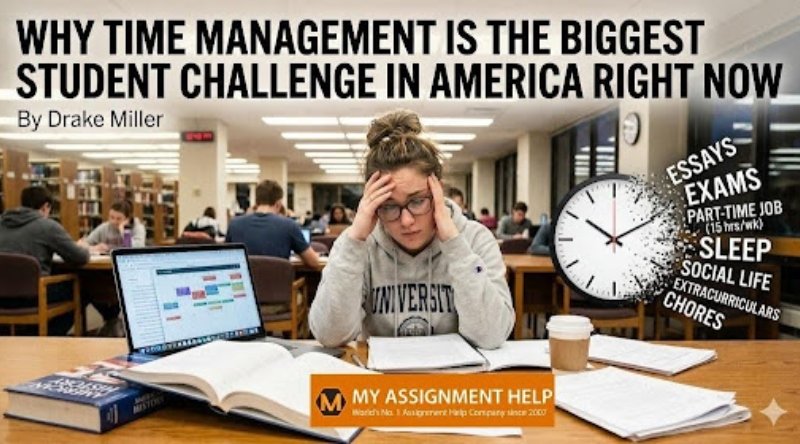
The life of a modern American student is no longer just about attending classes and passing exams. In 2026, the “student experience” has evolved into a high-stakes juggling act involving rigorous academics, extracurricular dominance, part-time jobs, social media presence, and the looming pressure of a highly automated, competitive job market.
At the heart of this storm lies a singular, defining struggle: Time Management.
While procrastination has always been a student trope, the current landscape has turned time management from a soft skill into a critical survival mechanism. For those struggling to keep their heads above water, identifying the right academic help resources has become a necessary strategy to maintain mental well-being. But why exactly is managing twenty-four hours a day suddenly the biggest hurdle for students in the USA?
The Hyper-Involvement Culture and the 4.0 Fallacy
In the United States, the college admissions process and the entry-level job market have become increasingly holistic—and increasingly demanding. It is no longer enough to have a 4.0 GPA. Students are expected to be “well-rounded,” which often translates to being dangerously “overextended.”
High schoolers are pressured to lead clubs, play varsity sports, and volunteer, all while taking a full load of Advanced Placement (AP) classes or navigating the IB Diploma Programme. For college students, the pressure shifts toward securing multiple internships and building a professional brand on LinkedIn before they even graduate.
This culture of hyper-involvement leaves zero margin for error. When every minute of the day is pre-allocated, a single unexpected assignment or a minor health setback can cause the entire deck of cards to collapse. This “hustle culture” creates a state of chronic “time poverty,” where students feel they are constantly behind, regardless of how much they accomplish.
The Digital Distraction Dilemma: Navigating the Attention Economy
We cannot discuss student time management 2026 without addressing the elephant in the room: the smartphone and the evolution of the “Attention Economy.” American students are the first generation to navigate an entire academic career with a dopamine-triggering device in their pockets.
The algorithms powering today’s social platforms are designed to keep students scrolling. Research suggests that the average student loses hours each day to “micro-procrastination”—the habit of checking a notification “for just a second,” only to emerge from a social media rabbit hole 45 minutes later.
This constant switching between deep work and digital distraction leads to what productivity experts call “attention residue.” When you switch from an essay to a text message, a part of your brain remains focused on the previous task for up to 20 minutes. This makes it significantly harder to refocus on complex tasks like essay writing, mathematical problem-solving, or programming assignment help at Myassignmenthelp.com , effectively lowering your functional cognitive capacity during study sessions.
The Mental Health Component: Burnout and Executive Dysfunction
Time management isn’t just about planners and stopwatches; it’s a cognitive function. High levels of stress and anxiety—which are at record highs among U.S. students—directly impair the brain’s executive function, located in the prefrontal cortex.
When a student is overwhelmed, they often experience “task paralysis” or “ADHD-paralysis.” The sheer volume of work creates a freeze response. This isn’t laziness; it is a biological response to an unsustainable workload. The student wants to work, but the brain cannot decide where to start, leading to more lost time and increased guilt, creating a vicious cycle of academic burnout.
For many, the challenge isn’t a lack of will; it’s the need for a structural reset. Recognizing when the cognitive load has exceeded your capacity is a sign of maturity. Whether it’s through peer tutoring or choosing to pay to do assignment tasks to lighten the load, finding a way to offload the pressure is often the only way to break the paralysis and regain momentum.
The Shift to Hybrid and Online Learning Structures
Since the early 2020s, the American education system has permanently embraced a hybrid model. While this offers flexibility, it places a massive burden on the student’s ability to self-regulate. Without the physical structure of a classroom or a set library schedule, many students struggle to create their own boundaries.
The home, once a place of rest, has become a place of work. This blurring of lines makes effective time management nearly impossible for those who haven’t yet mastered self-discipline. To succeed in US college life in 2026, students must essentially become their own project managers, a skill that is rarely taught explicitly in the traditional curriculum.
Actionable Strategies: Reclaiming the Clock in 2026
If you are a student feeling the weight of the clock, hope is not lost. Mastering time management in the modern era requires a shift from “managing time” to “managing energy and priority.”
1. The Eisenhower Matrix: Mastering Priority
Not all tasks are created equal. High-achieving students use the Eisenhower Matrix to categorize their to-do list into four quadrants. This prevents the “urgency trap” where you spend all day doing small tasks that don’t actually move the needle on your GPA.
- Urgent and Important: Do it now (Final exams, immediate deadlines).
- Important but Not Urgent: Schedule it (Long-term research papers, exercise, networking).
- Urgent but Not Important: Delegate or minimize (Administrative emails, minor chores).
- Neither: Delete (Mindless scrolling, excessive gaming).
2. Time Blocking and “Deep Work”
Instead of a vague to-do list, use “Time Blocking.” Assign specific hours of your day to specific tasks. For example, 2:00 PM to 4:00 PM is reserved strictly for “Deep Work” on History research. During these blocks, use “Airplane Mode” to eliminate attention residue. This prevents the “decision fatigue” that happens when you spend thirty minutes just wondering what you should work on next.
3. The Pomodoro Technique for the TikTok Generation
To combat the digital distraction dilemma, try the Pomodoro Technique: 25 minutes of intense, focused work followed by a 5-minute break. In 2026, many students are extending this to 50/10 intervals to accommodate deeper focus. This trains your brain to focus in short bursts and provides a scheduled “reward” for your attention, making long study sessions feel manageable.
4. Active Recall and Spaced Repetition
If you manage your time but spend it studying inefficiently, you are still wasting “time.” Active Recall—the process of testing yourself rather than just re-reading notes—is the most time-efficient way to learn. Combine this with Spaced Repetition software to ensure you are only studying what you are about to forget. This can cut study time by up to 30%, freeing up hours for extracurriculars or rest.
5. Leveraging Professional Support Systems
In the high-pressure environment of US Higher Education, seeking help is a strategic move. When the workload becomes physically impossible to manage within 24 hours—such as when multiple midterms coincide with a varsity game or a work shift—using a support service like MyAssignmentHelp can prevent total burnout. Having a backup plan isn’t “cheating” the clock; it’s managing your resources effectively.
The Role of AI in Student Productivity
As we move further into 2026, AI Fluency is becoming a time-management tool in itself. Students are using Agentic AI to help structure essay outlines, summarize massive research papers, and generate practice quiz questions. However, the challenge is using these tools to enhance learning rather than replace it. Learning to prompt effectively can save a student 5–10 hours a week on administrative academic tasks, allowing them to focus on high-level critical thinking.
The Bottom Line: Moving from Surviving to Thriving
Time management is the biggest challenge for American students today because the environment is rigged against it. Between the demands of a “hustle culture,” the lure of the digital world, and the rising cost of academic failure, the pressure is immense.
However, by understanding the psychological roots of procrastination—such as task paralysis and attention residue—and utilizing the right tools and support systems, students can reclaim their schedules. Remember, the goal isn’t to do everything—the goal is to do what matters most, effectively and without sacrificing your mental well-being.
Success in 2026 and beyond won’t be defined by who stayed up the latest, but by who managed their energy the best.
Frequently Asked Questions
Q.1 Why is time management harder for students in 2026 than in previous years?
The academic landscape in 2026 is defined by “Information Overload.” Between the integration of AI tools, the expectation of being “digitally fluent,” and a more competitive, globalized job market, students are processing more data daily than previous generations. Additionally, the “Attention Economy” has become more sophisticated, making digital distractions harder to resist without specific cognitive training.
Q.2 How do I stop “Task Paralysis” when I have too much work?
Task paralysis often stems from a lack of clarity. The best way to break it is the “Five-Minute Rule”: commit to working on your most daunting task for just five minutes. Often, the hardest part of time management is the transition into work. Once the “activation energy” is spent, continuing becomes much easier.
Q.3 Is using academic help services from Myassignmenthelp.com considered good time management?
Yes, when used as a strategic resource. In a professional setting, managers delegate tasks to meet deadlines; similarly, students must learn to manage their “capacity.” Using support services to handle overwhelming workloads can prevent burnout and allow a student to focus on their primary learning objectives during high-stress periods like finals week.
Q.4 What are the best time management apps for US college students?
While apps vary by preference, the most effective tools in 2026 include Notion for all-in-one organization, Forest for gamified focus sessions, and Google Calendar for strict time-blocking. However, the tool is less important than the framework (like the Eisenhower Matrix) used to drive it.
Q.5 Can the Pomodoro Technique work for complex subjects like Calculus or Organic Chemistry?
For “Deep Work” subjects, a standard 25-minute Pomodoro might be too short to reach a state of “flow.” Many STEM students in the USA now utilize “Flowtime,” where you work for 50–90 minutes followed by a 10–15 minute break. This allows enough time to wrap your head around complex formulas without being interrupted by a timer.
About the Author
I am a passionate blog author associated with Myassignmenthelp.com , creating insightful content on education, student life, academic trends, and study support. With a strong interest in helping learners navigate challenges, Drake shares practical advice, expert tips, and engaging perspectives. His writing focuses on empowering students with knowledge, resources, and guidance for academic and personal growth. For more details, Click here